Fencing a Sloped Yard: What Changes and What to Ask
Ground that isn't flat changes how a fence gets built, and it's worth knowing the options before you pick a material.
September 15, 2026 · 3 min read
Flat Ground Makes This Easy. Slopes Don't.
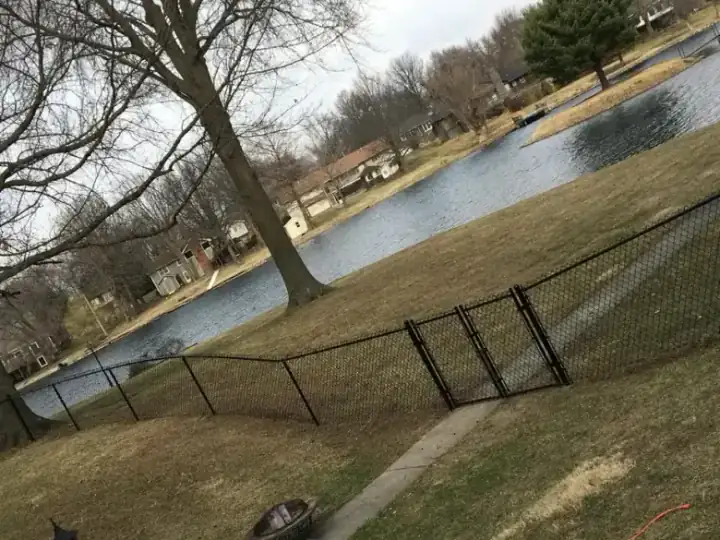
Most fence quotes assume flat ground, because most yards are close enough to flat that it never comes up. A lot of Central Missouri properties have a real grade to them, though, a slope down toward a treeline, a low spot along one side, a rise up to a shed. When that's the case, the fence has to make a decision the yard already made for it: does it follow the ground, or does it step down in flat sections.
This isn't only a look question. It affects gaps at the bottom of the fence, how a gate on the slope swings and latches, and which materials handle the grade gracefully in the first place.
Racked Fencing: Following the Ground
Racked, or raked, fence panels are built or adjusted so the top rail runs parallel to the slope, angling down with the ground rather than staying level. Pickets stay plumb while the rails between them lean with the grade. Finished, it reads as one continuous line following the yard, which a lot of people find the more natural-looking option on a gentle, consistent slope.
Racking works best when the slope is fairly even. A steady grade racks cleanly; a slope that changes pitch partway down, flattens out and then drops again, is harder to rack well and usually points toward stepping instead.
Stepped Fencing: Flat Sections, Staggered Down
A stepped fence keeps each panel level, like a flat little fence segment, and steps the whole run down the slope in stages, the way stair treads work. That gives you a clean, uniform panel line and a flat top rail throughout, which some homeowners prefer visually over a fence that visibly tilts.
The trade-off is what happens underneath each step. Since panels stay level while the ground keeps dropping, you get a triangular gap at the low end of each panel where the fence rises above the actual grade.
Why the Gap at the Bottom Matters
That gap is the real practical question in a stepped fence, and it's worth asking about directly before you commit to a look. On a steep or uneven slope those gaps can be large enough for a small dog to squeeze under, or for a toddler chasing a ball to find a way through without much effort.
Racked fencing mostly avoids this because it follows the ground, though even a racked fence has a small gap here and there where the terrain isn't perfectly smooth. If keeping animals in or kids contained is the actual goal of the fence, ask directly how the bottom gap will be handled on your specific slope, not just what the panel style will look like.
- Ask whether your slope will be racked or stepped before you pick a material
- Ask how any bottom gap will be closed if you have dogs or small kids
- Walk the fence line yourself and point out where the grade changes
How a Slope Changes the Material Conversation
Vinyl panels can be racked to a point, but there's a limit to how far a rigid vinyl rail will flex before it's stressed, so a steep slope sometimes pushes the conversation toward wood or metal, which handle custom-angled rails more easily. Wood rail can be cut and set to whatever angle the ground calls for on site, part of why wood remains a common choice on hillier lots.
Ornamental metal fence can also be racked, and it tends to show the slope less dramatically than a solid panel does, since you're looking through the fence rather than at a solid painted or capped surface. Chain link handles a moderate grade reasonably well too, since it's flexible by nature, though it's worth confirming with whoever measures your yard how it will be tensioned along the slope.
What Doesn't Change on a Slope
A grade in the yard doesn't change what's included with the install itself. CR Fence still offers a free estimate before anything is ordered, a one-year workmanship warranty once the fence goes in, and full licensing and insurance regardless of whether your yard ends up racked or stepped.
If your yard has any real grade to it, it's worth having someone look at the actual slope in person rather than guessing from a flat quote. CR Fence can tell you on site whether your property racks cleanly or needs a stepped approach. Call (660) 463-2597 to get someone out to walk it with you.
CR Fence LLC, (660) 463-2597
Call (660) 463-2597More articles
Vinyl or Wood: Choosing a Privacy Fence in Missouri
The honest trade-off between a fence that needs upkeep and a fence that needs a bigger check upfront.
Fencing a Farm or Ranch: Paddock, Pasture, and Lane
What actually differs between paddock rail, pasture fence, and lane gates on a working Central Missouri property.