Wood
Wood Fences
Cedar or treated timber, built the way the top and the gate actually get used, not just the way it photographs on day one.
Chapter 01
Cedar or treated timber
Both are in our own catalogue as separate offerings, cedar wood fencing and treated wood fencing, because the choice genuinely depends on what you want out of the fence. Cedar carries natural oils that resist rot and bugs on its own, and it weathers to a soft silver-gray if you leave it unfinished, or it takes stain well if you want to hold the color.
Treated timber is pressure-treated to resist rot and insects chemically rather than naturally, and it's the more budget-friendly route for the same footprint of fence. Neither is the wrong answer. It comes down to whether you want the cedar look and are willing to maintain it, or you'd rather treat it once and move on.
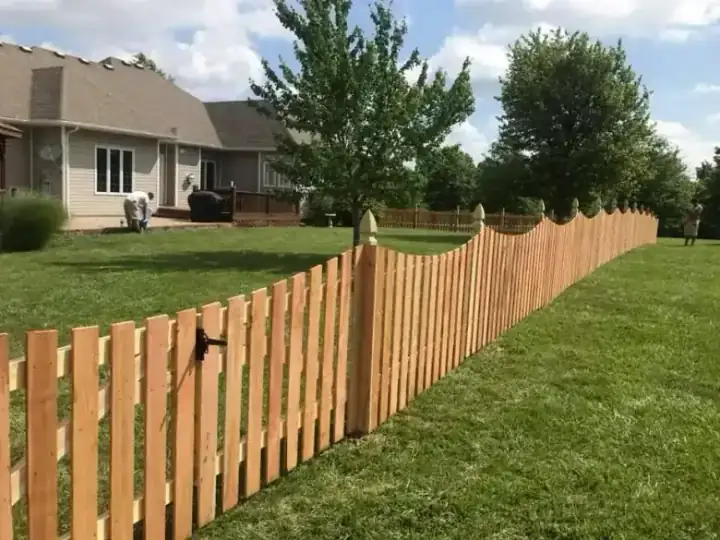
Scalloped top natural cedar picket fence along a front garden
What weathering actually does to a wood fence
Left unfinished, wood silvers evenly if it's getting even sun and airflow, and unevenly if one side of the yard is shaded and the other isn't, that's normal and not a defect. What isn't normal is cupping, boards bowing across their width, which usually comes down to spacing that was too tight for the wood to move with humidity, or a top rail that isn't doing its job of keeping the whole run straight.
Staining slows the silvering and adds a layer of UV and moisture resistance, but it isn't a one-time fix, it needs reapplying on a cycle to keep doing its job. Board spacing and a solid top rail matter more to how the fence holds its line over years than the finish does.
Chapter 03
Tops and profiles we build
Scalloped picket with gothic post caps is a classic front-yard look, the top rail dips in a shallow curve between posts rather than running dead flat. We also build arched gates, where the gate itself rises to a peak in the middle, and flat-top privacy runs for when the point is the fence, not the silhouette.
On the modern end we've built horizontal cedar plank fencing set into black steel posts, a cleaner, more contemporary line than a traditional picket run. It's a different look entirely from a scalloped front fence, worth considering if the house itself leans modern.
The gate is the part that actually gets used
Every other section of a wood fence just stands there. The gate swings, gets pushed, gets left open, gets slammed shut by a kid running through, hundreds of times a year, and that's exactly why it's usually the first thing to fail on a wood fence. Hinges carry the whole weight of the gate on every open and close, and undersized hinges or an under-supported gate post will show up as sag within a season or two.
When you're speccing a gate, ask what hinge hardware is going on it and how the gate post itself is set, not just what the gate looks like. A gate that's been built to carry its own weight over years is worth more than one that just looks right in the estimate photo.
CR Fence, family owned since 2000, fully licensed and insured. Free estimates. Call (660) 463-2597.