Fencing a Farm or Ranch: Paddock, Pasture, and Lane
What actually differs between paddock rail, pasture fence, and lane gates on a working Central Missouri property.
September 15, 2026 · 3 min read
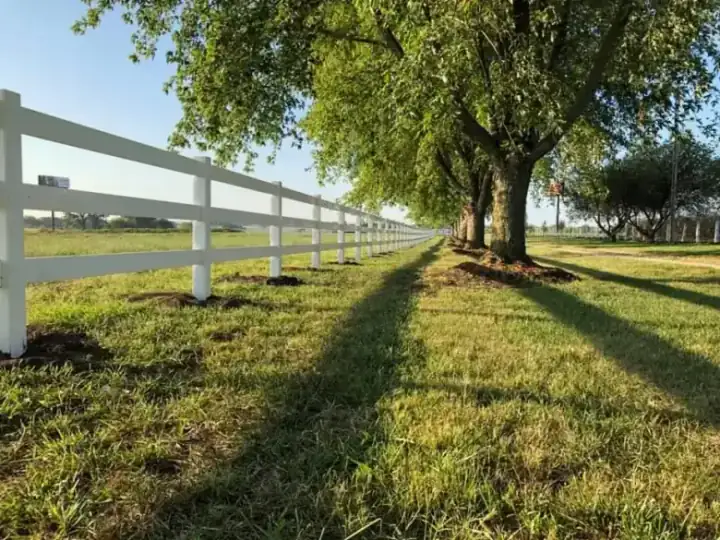
A Working Fence Has a Different Job
A backyard privacy fence and a paddock fence are solving different problems. A privacy fence has to block sightlines and hold a fixed panel line. A working fence has to hold livestock in, handle equipment moving through gates, run for long distances along property lines, and survive years of weather with a lot less daily attention than a suburban yard gets.
That's the mindset worth bringing into the material conversation. The question isn't only what looks good along a lane, it's what a long run of fence will still be doing its job like five or ten years from now with minimal upkeep.
Three Rail vs Four Rail
Three rail fencing is the standard for a lot of pasture and paddock work, spacing three horizontal rails to keep larger stock like horses and cattle contained and visible from a distance. It's a familiar look along Central Missouri roads for a reason: it's proven and it reads clearly as a boundary.
Four rail adds a rail low enough to matter for smaller or younger animals, foals, smaller livestock, or anywhere you want a tighter barrier without switching to a solid panel. The extra rail means more material and more posts over a long run, so it's worth thinking about which parts of the property actually need that tighter spacing and which don't.
Post and Rail, and Where Drape Fence Fits
Post and rail is the broader family that three rail and four rail belong to, and it's worth knowing as its own category, since the spacing and rail count can be adjusted to the property rather than treated as one fixed product. Drape fence, a coated wire mesh hung behind the rail line, adds a layer that keeps smaller animals from pushing through the gaps between rails, without losing the classic rail look from the road.
Drape is worth asking about specifically if you're running anything smaller than cattle or horses, dogs on the property, sheep, goats, poultry that roam, since plain rail spacing alone won't stop something small enough to fit between the boards.
Sizing Gates for What Actually Has to Get Through
This is the detail that gets missed most often on a working property. A gate sized for a pickup truck is not automatically wide enough for a tractor with an attached implement, a stock trailer, or a combine during harvest season. Before a gate location and width get locked in, it's worth walking through every piece of equipment that will ever need to pass through it, not just the vehicle you use most.
- Measure your widest implement, not your truck, and add clearance on both sides
- Think about turning radius approaching the gate, not just the gate's open width
- Decide now if a second, smaller walk-through gate would save opening the main one for foot traffic
It's a lot cheaper to size a gate right the first time than to widen an opening and reset posts after the fact.
Vinyl Rail vs Wood Rail Over a Long Run
On a long fence line, vinyl rail's main advantage is that it doesn't need repainting or restaining across what might be a quarter mile or more of fence, which adds up in both time and cost over the years compared to wood. It holds its color and doesn't split or splinter the way sun-weathered wood can.
Wood rail costs less to install initially and is easier to repair in a single spot, you can replace one damaged rail without disturbing the rest of the run, whereas a damaged vinyl rail section usually means swapping a full piece. Which one wins out often comes down to how long you plan to own the property and how much fence maintenance you want on your own list versus built into the material.
A Company That Handles Serious Fence Work
Agricultural fencing is one of CR Fence's core lines, alongside vinyl, wood, decorative metal, and chain link, and the company has a track record with demanding projects: CR Fence installed the perimeter security fencing for the B-2 Spirit Bomber Program at Whiteman Air Force Base. A farm gate or a long paddock run gets the same attention to getting the layout right.
Every working property is laid out a little differently, and the right combination of rail count, drape, and gate placement really depends on walking the actual paddocks and lanes. CR Fence offers free estimates for farm and ranch work across Central Missouri, and every install carries a one-year workmanship warranty. Call (660) 463-2597 and they'll come look at the ground with you.
CR Fence LLC, (660) 463-2597
Call (660) 463-2597More articles
Vinyl or Wood: Choosing a Privacy Fence in Missouri
The honest trade-off between a fence that needs upkeep and a fence that needs a bigger check upfront.
Fencing a Sloped Yard: What Changes and What to Ask
Ground that isn't flat changes how a fence gets built, and it's worth knowing the options before you pick a material.