Farm and ranch
Agriculture Fences
Fencing a working property is a different job from fencing a back yard, long runs, gates sized for equipment, and rails that have to hold up season after season.
Chapter 01
A working property fences differently
A paddock, a pasture line and a lane aren't the same fencing problem as a residential back yard, even though the same crew can build all of it. A back yard fence is mostly about a boundary and a gate. A working property fence has to hold stock in or out over acres, survive weather with nobody checking it daily, and still let equipment and vehicles through where they need to.
That's the range we build to on a farm or ranch job. Post And Rail, 3 Rail and 4 Rail runs for pasture and paddock boundaries, and Drape Fence for the softer, swagged look some property owners want along a lane or a front pasture.
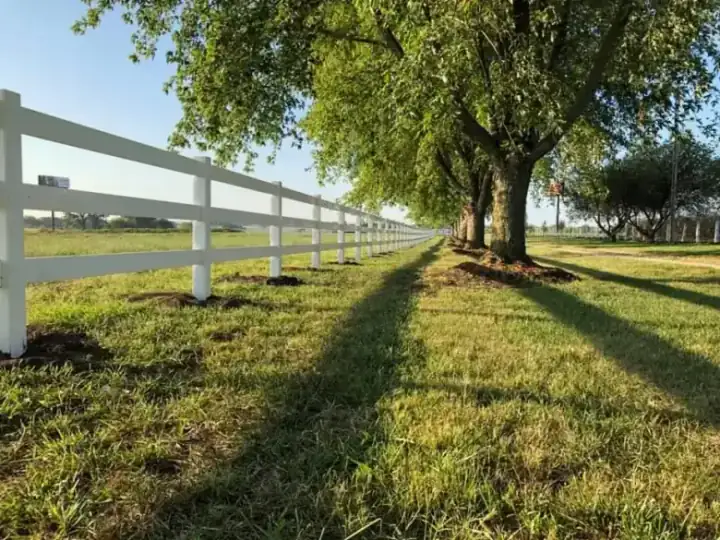
White vinyl three rail ranch fence running down a tree lined lane
Rail counts and what each one is for
The difference between a 3 rail and a 4 rail fence is exactly what it sounds like, one more horizontal rail, set lower, closing the gap nearer the ground. That extra rail matters more for some stock and some boundaries than others, a tighter bottom gap does more to keep smaller animals in or predators out than a wide-open 3 rail run does.
For a straightforward pasture boundary or a decorative property line where containment isn't the main job, 3 rail is often plenty and costs less over a long run. Where you're actually relying on the fence to hold specific stock, that bottom rail is worth talking through before you commit to a rail count.
Chapter 03
Long runs, gates and the corners that carry the load
A farm fence is measured in runs, not sections, and the two things that make or break a long run are the gates and the corners. A gate has to be sized for whatever actually needs to get through it, a tractor, a livestock trailer, a truck and manure spreader, not just wide enough to walk through. Get that wrong once and you're living with it for years.
Corner and end posts are where a fence line actually does its structural work, they're what the rails or the tension of the whole run pulls against, so they carry more load than anything in the middle of a straight stretch. We won't quote you a specific setting depth or bracing method over the phone before we've seen the ground, but it's worth knowing that's the part of the job doing the real work, not the rail itself.
Vinyl rail or wood rail on a farm
Vinyl rail, like the run in the photo above, doesn't need repainting or restaining, and it holds its color and its line over a long run with less upkeep than wood. On acreage where you're not out checking fence every week, that's real time saved over the years, not just a nicer finish on day one.
Wood rail costs less to put up initially and it's the traditional look a lot of property owners want, but it asks for maintenance on a cycle, staining or sealing, replacing a rail here and there as it weathers, especially over a run that's exposed to full sun and weather most of the year. Neither is wrong, it's a real trade-off between upfront cost and what you're willing to keep up with.
CR Fence, family owned since 2000, fully licensed and insured. Free estimates. Call (660) 463-2597.